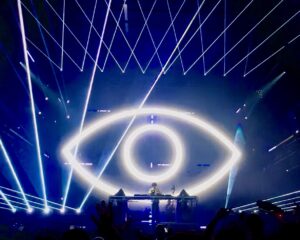









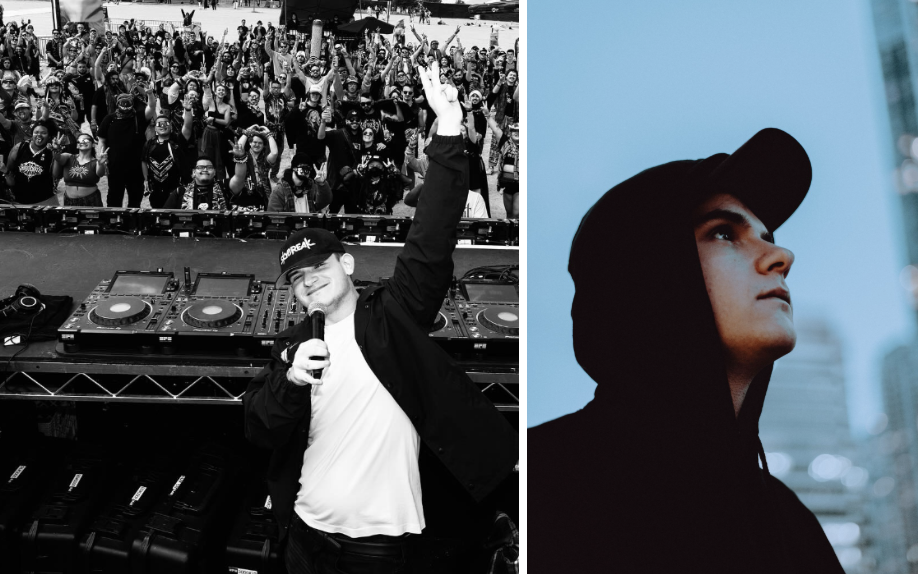
We had the chance to sit down with Skybreak, a boundary-pushing artist reshaping the landscape of modern bass music. Known for blending emotion and cinematic textures, his sound defies easy categorization—and so does his approach to creativity. In our conversation, we explored artistic identity, emotional storytelling, and how vulnerability plays a crucial role in building sonic worlds.
Sound Design & Influence
Kristen: How has the transit culture helped shape your music or career overall?
Skybreak: I’ve always had a fascination with trains. I remember even as a young kid walking through the airports and seeing the hyper-universally relatable signs up there thinking “this is so cool”, and I would make up little stories for them. I find public transit in specifically the cities London and New York that I grew up in really fascinating, because you’ve got these signs that are almost obvious what you’re supposed to do. They could even be interpreted as boring, you know, everything is in Helvetica, extremely readable, but the culture of the city seeps into this signage. I feel like public transit is a great description of the city’s culture. Just as people spray paint and sticker these public transit signs, I’m taking this canvas of music and spray painting it per se with elements of the work that I’ve done, so you end up with this universally relatable product, with the sketchings and culture that i’ve created through my work over the years.
K: What artists, either past or present, have helped influence you either during your writing processes or career as a whole?
S: Artists over the past few years that I’ve been closely associated with and have been a major help are Chime, Au5 and Temanite to name a few. Chime was the first artist that took a chance on me; I remember touring colleges while visiting Hoboken, NJ when I found out he had accepted my track “Whispers In The Forest” and thought: No way. My career’s made. We’re always constantly sharing new techniques and ideas and he’s come to be a really good friend of mine. He’s helped push me up to his level, he’s put me on his album tour, we even just finished a two show run in Japan together.
Another figure that comes to mind is Au5, I’ve been listening to his music since maybe 2012. He was one of the first artists I ever fell in love with in the EDM space and I remember getting a DM from him about an old glitch hop tune “Hydrofunk” where he’s like “Hydrofunk rules” and I’m all, no way, what the heck? But that also has blossomed into a great friendship. I’ve learned so much sound design from him and more so than anything his philosophy. He cares so deeply about the art in a way that’s unmatched; he is his art, and it’s an extension of his being. G-Jones is also a major one, and his Lost Lands 2022 set is actually what helped me gravitate towards this new public transit icon aspect.
Creative Philosophy
K: Speaking of artistic route and creation: how do you keep that healthy balance of having fun while you’re making music, but making sure you don’t get burnt out in the process?
S: I feel like that’s a bit of an asymptomic battle. I think a lot of artists struggle with this because we’re in a rare medium where a lot of our friends come from the scene, but also a lot of our money comes from the scene. And there’s also people trying to make money off of us. So, just distinguishing those can be extremely difficult. I’ve recently gotten into urban exploration, just finding abandoned buildings and getting up and telling myself that this is research and development when going out and having new experiences. I think the most genuine experiences come from human connections and experiences one can have.
K: If you could go back and tell yourself anything before dropping your first track, what would you say?
S: That is a difficult question becasue I feel like the only reason I am who I am today is because I naturally made mistakes and did my thing. So whenever I’m asked questions like this, I’m always like, oh, I don’t know if I actually would change anything. Instead of telling myself something too early on and overwhelming it, I want to find myself in the middle of the intermediateness and just, smack him across the face and say, it’s okay to make mistakes. Just have fun with it. Make what you want to make; you are under no obligation to anyone to make anything other than the art that’s moving you right now.
K: Out of everything that you’ve made, overall for your career or in the Half Blood era, what are some of the more meaningful tracks for you, and can you give us some insight into the creative processes that go into those?
S: So I think in terms of the Half Blood era, the two tunes from the project that mean the most to me, off the top of my head, would probably be “Antimatter” and “Street Garden”. “Antimatter” goes into remembering your goals. Putting aside the static when you’re viewed too much as this like, God figure. Because holding yourself up to that standard is just a recipie for imposter syndrome. So, it’s my process of putting that aside and just reducing art to art, and keeping it to back before I had all these expecations sitting on the line.
“Street Garden” is inspired by Duskus’ Healers Vol. 1, which is just chill house songs. I think he calls it “romantic rave” and I wanted to give that genre a go, because in my opinion, it’s chill and it’s emotional, but it’s also groovy and kind of pounds in the club. So I wanted to try something like that.
K: One of my favorite things about you is you pack such passion into the things you create, which really shines through. I feel as if it almost hits different when things feel genuine. I apprecaite it from a listener standpoint because it makes it more enjoyable; it’s like “damn, this person put so much effort, love and care into this” and it’s just way more fun to listen to stuff like that.
Achievements & Accomplishments
K: What’s the most meaningful or wild reaction you can think of when entering this new era of Skybreak?
S: Playing in Nagoya and Tokyo, Japan last month was really cathartic for me. I have premiered a lot of the Half Blood stuff at festivals etc. and it went very well. People seemed to enjoy the tunes and I was able to premiere the live visuas but at a festival, unless you are a big headliner, a lot of people are esentially discovering you for the first time, and it’s not as easy to generate hype. I wouldn’t have it any other way though, I think giving them the fully realized version that I’m into right now is a nice “take it or leave it” as an artist. But when I played Nagoya and Tokyo, the people in the crowd just loved every part of Half Blood. I split the set into two parts, the first half being past Skybreak and the second being future, Half Blood Skybreak, and the fact there was not much of a difference in reaction and people accepted all the music just meant a lot to me.
On a personal more microscopic level, I was at Stay In Bloom Festival which is Dabin’s show in New York City, and we were just chilling on the couch when Dabin came over and told me how my project was one of the most exciting projects in bass music for him at the moment. Saying he can tell how much effort has been put in not only the visual direction, but also the music and how we’re telling stories that go well beyond that, and just how proud he is overall. Hearing that meant a lot because I went on my first ever bus tour with him, and that to me was the real shift between being this cute little kid making dubstep on his computer to now, an artist and a fully realized human who was just thrown into the fire and forced to adapt. And I don’t think I would’ve been the same person without it, but to have the person that made that possible telling me this project is dope and I should be proud of it truly meant a lot.
K: You’ve done everything from playing Starbase, giving lectures at Berklee College of Music, and even playing over in Japan. What has felt like the biggest personal leap for you in all of that?
S: I feel like all three could be a personal leap in their own regard. I think Starbase obvisouly means a lot becuase Slander were very early supporters of my project. My first show ever was with them in Seattle in 2021, they signed my Unity EP on their Heaven Sent imprint all those years ago, and now we even have some exciting things up and coming soon as well. I’m just so grateful to have people so widely respected behind my project. It just meant a lot for them to put me on a festival like that, it really made my day.
And Berklee, DUH! Being able to represent bass music and academia like that felt like such a step forward for everyting I’m about. There is a lot that goes into music production, especially the genre. I know a lot of people are here for the Shrek visuals and silly fun, but bass music is an art form in its own regard, and it can go as deep as something more widely respected like classical music or jazz. It just needs to be given the platform. And to be given that platform, especially at the highest institution of music in the U.S. in my opinion, was pretty dang wild.
But I think out of everything, Japan probably meant the most to me. My project has been so deeply insipired by Japanese arts, music, and media, since its inception. And to go and kind of give back, and play these sold out shows with one of my best friends and earliest supporters, having it stacked with fans, getting to experience the country; I just feel so blessed and lucky to do it. When I was there I climbed a mountain adjacent to Mount Fuji and this 80 year old women climbs it every day, and serves this traditional Japanese rice beverage called amazake, just to hikers. No road to get there, she climbs everyday. It’s the things I was able to experience in a country that truly believes in perserverance. Just the sheer idea of playing my art 7,500 miles away, not at a festival, but on a headline show, meant so much to me. I am still beaming from that trip, I’m nerver going to forget it.
Skybreak’s journey is a testament to what happens when technical mastery meets emotional depth. He’s translating the human experience into sound, layering each track with intent, identity, and imagination. In a scene that often prizes predictability, Skybreak continues to defy expectations and carve out space for honest, genre-bending expression. Whether he draws from jazz roots or builds cinematic basslines, his music invites listeners to feel something real. One thing is for sure: we can’t wait to see what the future holds.